
 Wenzhou Lita Electric Co., Ltd.


How to Tell If a Circuit Breaker Is Bad
When a maintenance supervisor in Manchester encountered repeated trips on a packaging line, he watched a reset video, replaced the breaker, and confidently restarted production. Two hours later, the new device tripped and a panel scan found a hot termination; the real fault was a loose connection and an overloaded circuit. The original breaker was not necessarily defective—it may have been doing its job. The investigation therefore began with the right question: how to tell if a circuit breaker is bad rather than merely inconvenient?
Summary: Knowing how to tell if a circuit breaker is bad requires more than counting trips. A breaker may be defective if it will not reset with the load isolated, has visible heat damage, a loose or inconsistent mechanism, abnormal terminal temperature, or fails calibrated trip testing. Repeated tripping more often indicates overload, short circuit, ground fault, arcing, loose connections, or unsuitable load characteristics. Qualified personnel should isolate the cause, verify rating and connections, and follow NFPA 70E work practices.
A guide on how to tell if a circuit breaker is bad must separate bad breaker signs from signs of a bad circuit. A circuit breaker is an automatically operated protective device that opens under specified overcurrent conditions; UL 489 covers many molded-case and miniature circuit breakers used in North American distribution. Because its purpose is to trip, frequent operation alone does not prove failure. Diagnosis starts with the load and fault history, then moves toward the device.
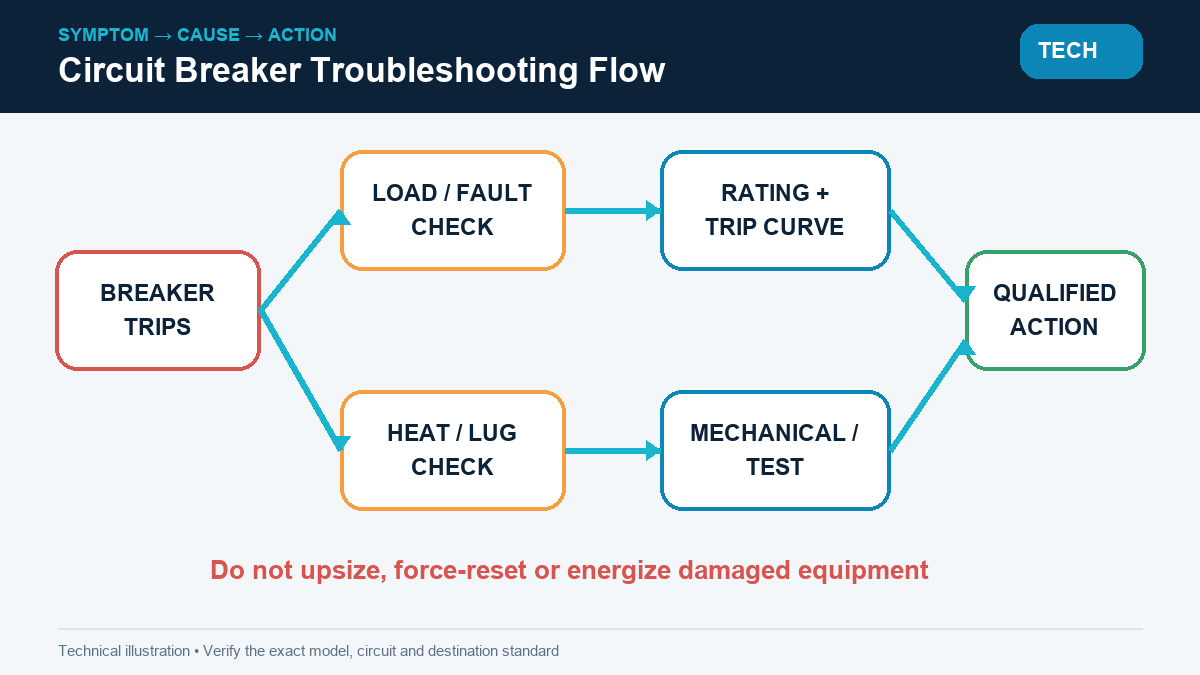
Symptom: The Breaker Will Not Reset
Likely causes
The handle may not have been moved fully to OFF before reset, or the downstream circuit may still contain a short circuit or ground fault. Mechanical damage is possible, but forcing the handle or holding it closed is unsafe.
Recommended action
A qualified person should isolate downstream loads, inspect for damage, and follow the manufacturer’s reset procedure. If the breaker will not latch with the circuit safely isolated—or if it feels loose, gritty, or inconsistent—it should remain de-energized and be evaluated or replaced with an approved equivalent.
Symptom: The Breaker Trips Under Normal Load
Likely causes
The actual load may exceed the rating, motor or LED inrush may be too high for the trip curve, ambient panel temperature may raise thermal response, or a conductor may be loose. For continuous loads, NEC sizing commonly applies a 125% factor unless equipment and rules provide another arrangement; simply increasing breaker amperage without conductor analysis is prohibited.
Recommended action
Record load current by phase, trip timing, ambient temperature, connected equipment, and recent changes. Compare these data with the breaker curve, conductor ampacity, terminal ratings, and equipment instructions. A calibrated primary-injection or manufacturer-approved test can determine whether the breaker operates outside tolerance.
Symptom: Heat, Odor, Buzzing, or Discoloration
Likely causes
Loose lugs, damaged bus contact, contamination, sustained overload, internal arcing, or an incompatible breaker/panel combination can generate heat. A hot spot at one terminal often indicates connection resistance rather than a defective trip mechanism.
Recommended action
Unusual odor, visible charring, melting, or active buzzing warrants prompt isolation under an electrical-safety procedure. Qualified technicians may use thermal imaging and de-energized torque/connection inspection, but damaged bus components require manufacturer or competent service evaluation—not cosmetic cleaning.
Symptom: Nuisance Trips Continue After Replacement
Likely causes
The replacement may have the same correct protective response to an unresolved overload, short, ground fault, neutral problem, or transient. GFCI/AFCI functions can also trip for reasons different from conventional overcurrent operation. A wrong trip curve or interrupting rating can introduce a new hazard.
Recommended action
Stop the parts-swapping cycle and trace the circuit systematically. The team should document which protective function operated, reproduce the load condition when safe, divide downstream branches, and escalate insulation, leakage, waveform, or coordination testing to qualified specialists.
Breaker Troubleshooting Table
| Symptom | More likely cause | Immediate boundary | Evidence needed |
|---|---|---|---|
| Trips at predictable high load | Overload or trip-curve mismatch | Reduce load; do not upsize blindly | Current log and trip curve |
| Trips instantly | Short circuit or severe inrush | Keep circuit off | Fault isolation |
| One hot terminal | Loose/damaged connection | Qualified isolation | Thermal and de-energized inspection |
| Will not latch unloaded | Mechanical defect possible | Replace/evaluate device | Manufacturer procedure |
| Charring or melted case | Severe overheating/arcing | Do not re-energize | Panel and bus assessment |
Field Action vs. Manufacturer Escalation
| Condition | Qualified field action | Escalate when |
|---|---|---|
| Known overload | Correct load or circuit design | Coordination remains uncertain |
| Loose accessible terminal | Inspect and repair de-energized to instructions | Bus or enclosure is damaged |
| Unknown trip performance | Review settings and history | Calibrated testing is required |
| Obsolete breaker | Identify exact panel and approved type | No listed replacement is available |
| Arc/heat damage | Secure and document the area | Always involve competent service |
Standards and Compliance
- UL 489: performance requirements for molded-case circuit breakers and related enclosures.
- NFPA 70: conductor protection, interrupting rating, panel compatibility, grounding, and installation rules.
- NFPA 70E: electrical safe-work practices, risk assessment, boundaries, and PPE framework.
- IEC 60898-1 / IEC 60947-2: breaker standards used for different IEC applications; devices are not interchangeable merely because current ratings match.
An unapproved replacement, wrong interrupting capacity, counterfeit marking, or improper field adjustment can leave fault energy uncontrolled. Consequences include equipment loss, fire, injury, failed insurance review, and tender disqualification.
Selection and Decision Guide
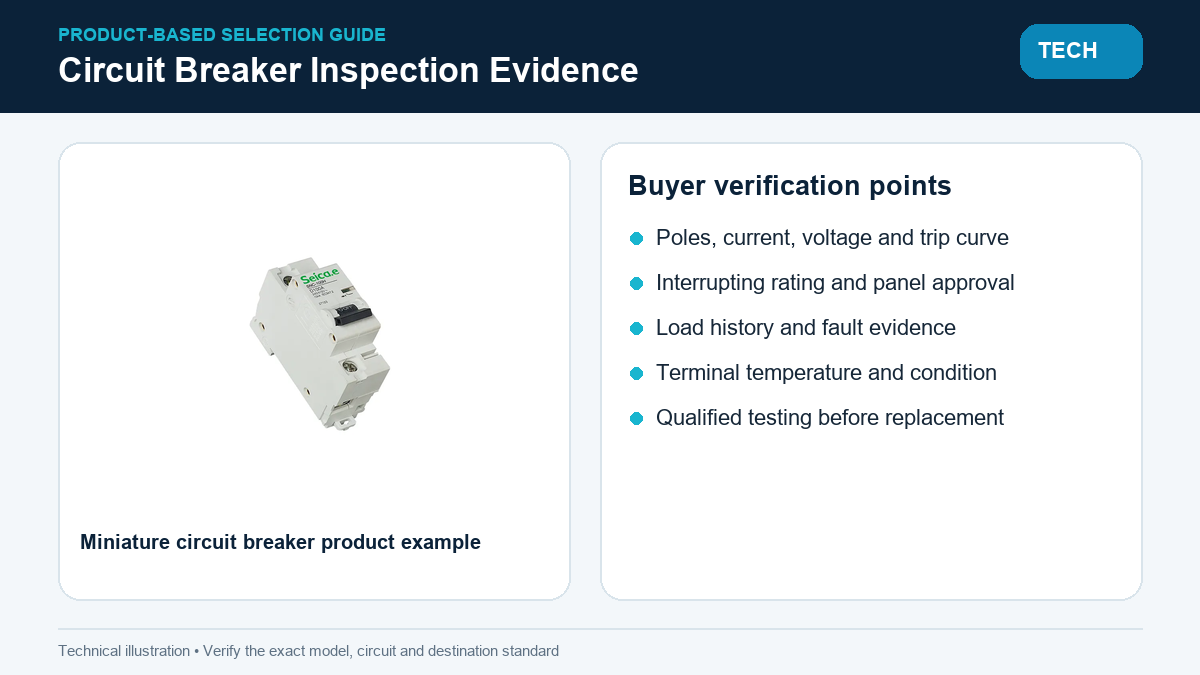
- Record manufacturer, model, poles, current, voltage, trip curve, and interrupting rating.
- Verify the breaker is approved for the exact panel or enclosure.
- Compare load history and fault evidence before condemning the device.
- Use calibrated testing or manufacturer evaluation when operation remains uncertain.
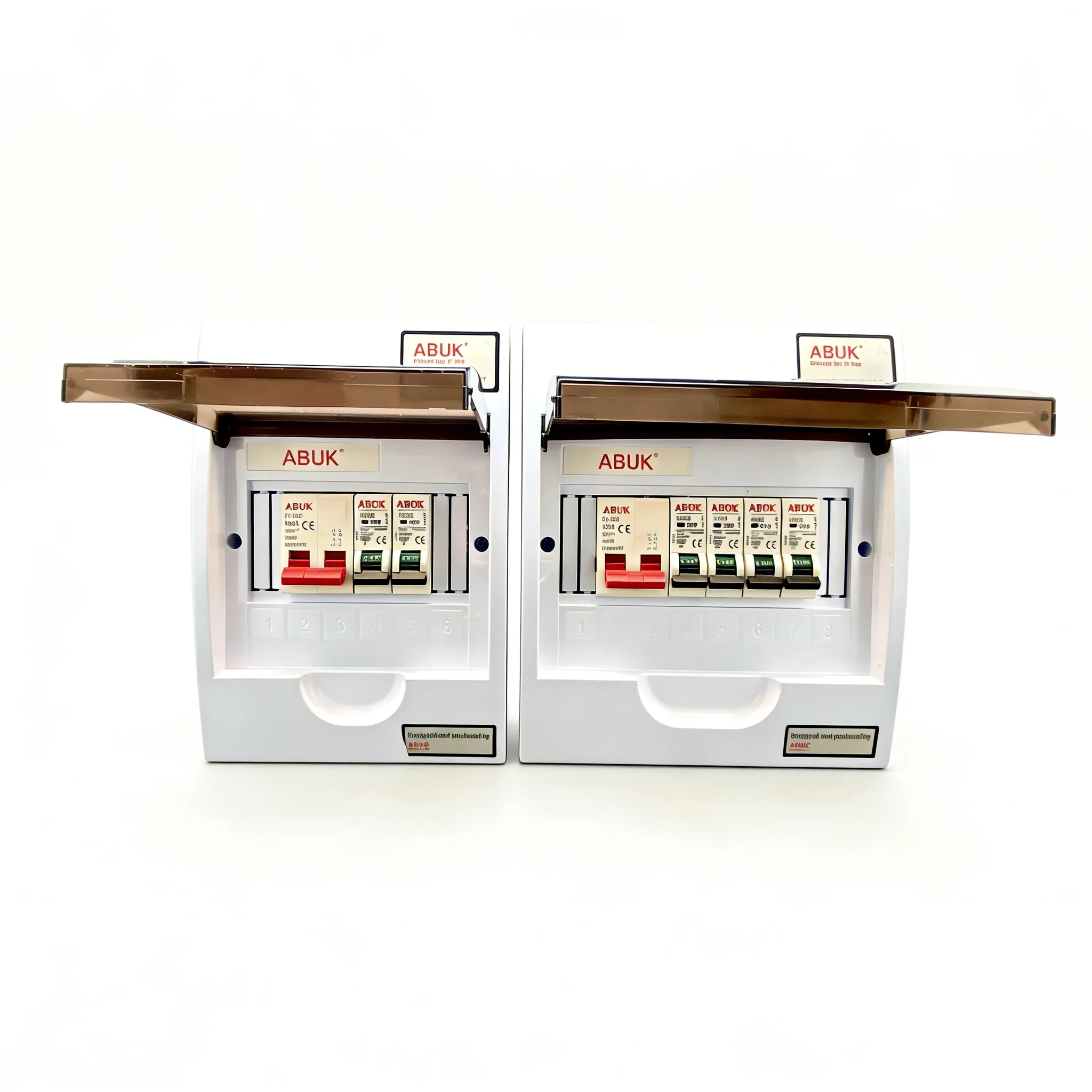
ABUK provides circuit-protection products and application support; its guide on how to tell if a circuit breaker is bad should be applied with CE, RoHS, and GCC documentation for applicable models and markets, plus the project’s required product standard.
Frequently Asked Questions
How to identify a breaker switch?
Read the panel directory, then verify the circuit by controlled isolation and testing. The breaker label should show manufacturer, type, poles, amperage, voltage, and interrupting rating.
Can a bad outlet trip a breaker?
Yes. Loose contacts, damaged insulation, short circuits, ground faults, or arcing at an outlet can operate the associated protective device.
How to tell if a circuit breaker is bad without removing the panel?
Users can document handle position, trip pattern, connected loads, odor, noise, and visible damage. Electrical measurements and panel access belong to qualified personnel; see the check circuit breaker product context.
What are the most common bad breaker signs?
Failure to latch with the load isolated, mechanical looseness, visible heat damage, abnormal terminal temperature, and failed calibrated trip testing are stronger evidence than tripping alone.
Can a circuit breaker be weak without tripping?
Mechanical or contact deterioration can occur, but “weak breaker” should not be guessed from age. Inspection, loading data, and approved testing are needed.
Should a repeatedly tripping breaker be replaced?
Not before the cause is identified. Replacement is justified when the device is damaged, incompatible, obsolete, or proven outside specification; otherwise the unresolved circuit fault will remain.
References
- UL 489 — Molded-Case Circuit Breakers
- NFPA 70 — National Electrical Code
- NFPA 70E — Electrical Safety in the Workplace
- OSHA — Electrical Safety
The decisive insight is that a breaker is an evidence-generating safety device: its trip should start an investigation, not a guessing contest.
ABUK builds circuit-protection solutions for that moment. Review the signs of a bad breaker with the technical team and provide the panel model, load data, and destination standard.