
 Wenzhou Lita Electric Co., Ltd.

What Is a 20 Amp 250 Volt Tamper-Resistant Outlet?
When an equipment buyer in Phoenix encountered a request for a 20 A workshop receptacle, he saw a T-shaped slot online, assumed it matched a kitchen outlet, and confidently approved a 250 V batch. The plugs did not fit, the circuit drawings showed two ungrounded conductors instead of line and neutral, and the safety review rejected the substitution. The devices were not malformed—the buyer had confused NEMA 5-20R and 6-20R configurations. The real question was: what is a 20 amp tamper resistant outlet rated 250 V?
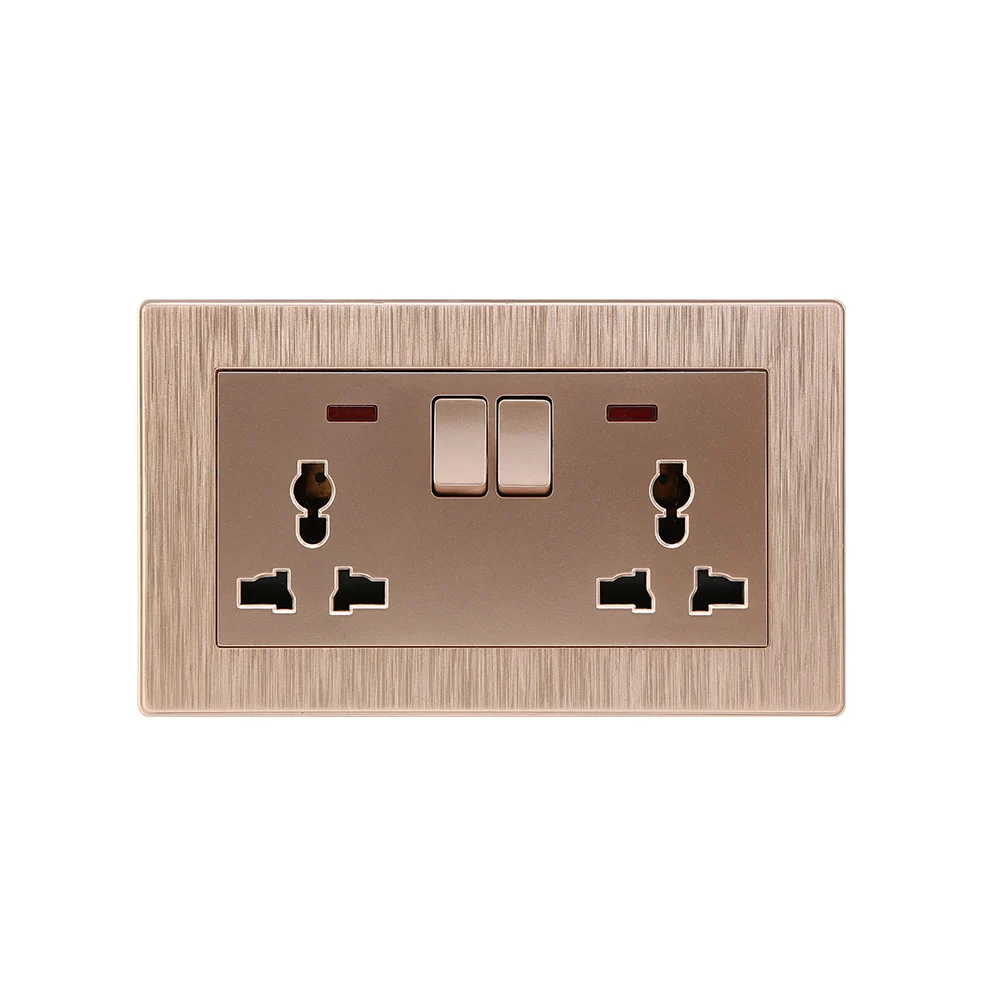
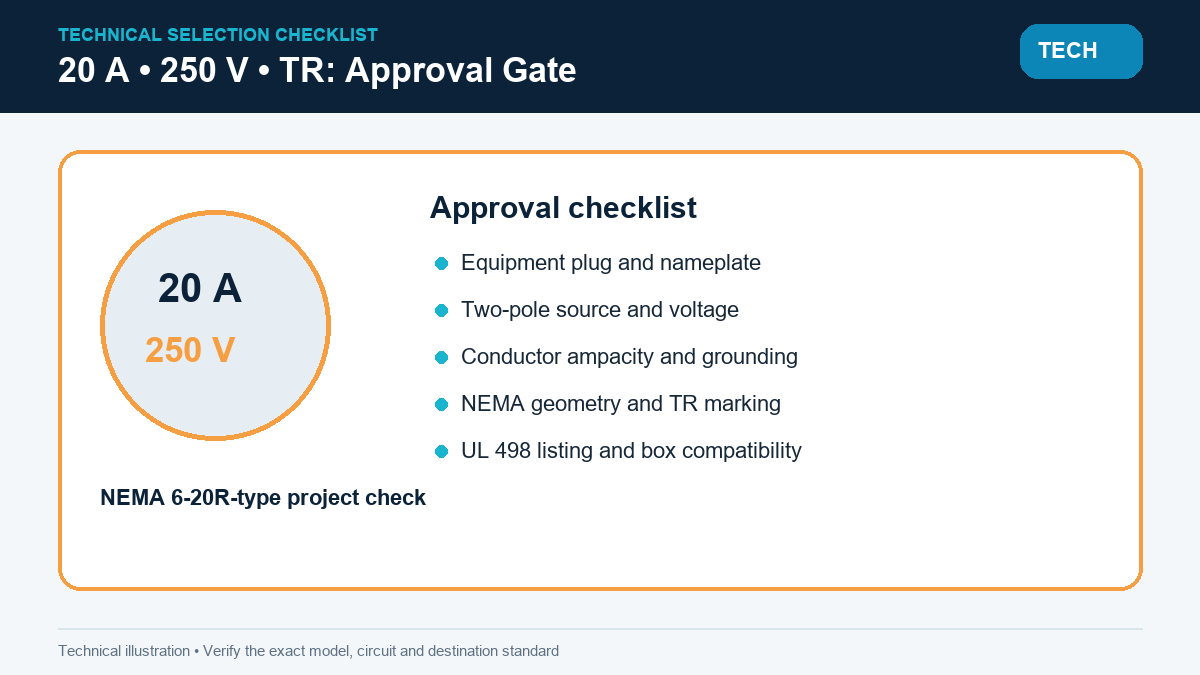
Summary: A 20 amp tamper resistant outlet rated 250 V is commonly a NEMA 6-20R-type device with coordinated internal shutters. It is intended for a 250 V-class branch circuit, normally using two ungrounded conductors plus equipment ground and no neutral for a straight 240 V load. It is not interchangeable with a 125 V NEMA 5-20R. Buyers must verify blade geometry, 20 A rating, branch circuit, conductor size, grounding, TR marking, UL 498 listing, box depth, and equipment plug.
A 20 amp tamper resistant outlet combines three independent specifications: current capacity, voltage/configuration, and shutter protection. NEMA WD 6 standardizes the interface, UL 498 addresses receptacle safety and tamper resistance, and NEC Articles 210 and 406 govern installation. The phrase “20 amp outlet” alone is incomplete because 5-20R and 6-20R devices serve different voltage systems and plug families.
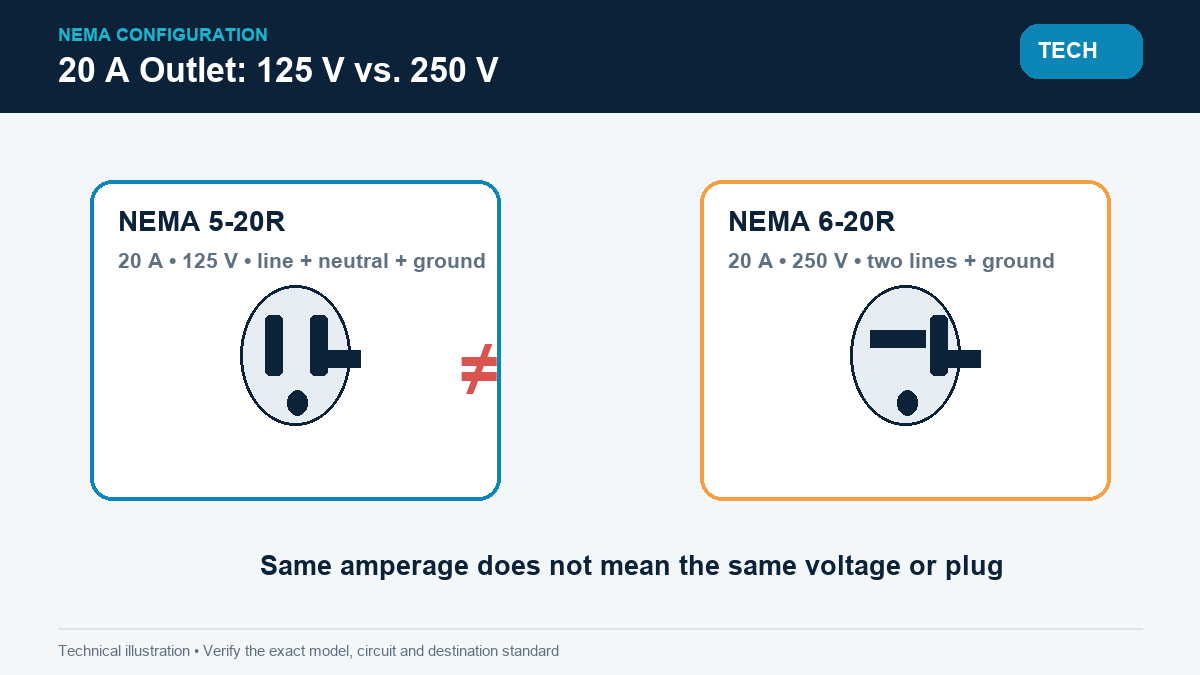
What Does 20 A, 250 V Mean?
The 20 A value is the receptacle’s current rating; 250 V is its voltage class, not a promise that every circuit measures exactly 250.0 V. In a typical U.S. 120/240 V split-phase system, the receptacle supplies about 240 V line to line. A NEMA 6-20R accepts the intended 6-series plugs and normally provides two ungrounded contacts plus equipment ground. It does not provide a neutral for 120 V loads.
How Is It Different from a 20 A, 125 V Outlet?
A NEMA 5-20R is rated 20 A, 125 V and uses line, neutral, and ground; a NEMA 6-20R is rated 20 A, 250 V and uses two ungrounded conductors plus ground. Both may have T-slot geometry, but the slot orientation prevents cross-connection. Changing the receptacle face does not convert circuit voltage. The breaker, conductors, source, grounding, and equipment nameplate must already form the correct system.
What Branch Circuit Is Normally Required?
A 20 A circuit commonly uses 12 AWG copper conductors, subject to insulation type, ambient temperature, derating, terminal ratings, and local code. A 240 V U.S. circuit generally uses a common-trip two-pole breaker and an equipment grounding conductor. NEC 210.21 links receptacle rating to branch-circuit rating, while NEC 240 and 250 govern overcurrent protection and grounding. Manufacturer torque and conductor range remain mandatory.
How Does a 20 Amp Tamper Resistant Outlet Change the Device?
Internal shutters resist access through a single blade opening and move when the intended plug blades enter together. The TR feature does not change voltage, interrupt ground faults, or make an indoor device weather resistant. If the adopted NEC requires tamper-resistant receptacles for the occupancy, the exact 250 V model must carry the relevant marking and listing evidence; a separate outlet cover is not equivalent to integral shutters.
Where Do Hidden Costs Appear?
If 60 workshop points are ordered in the wrong NEMA configuration and each correction takes 0.5 labor-hour at USD 50, labor reaches USD 1,500 before new devices, lockout time, and equipment delay. Over-specifying TR where it is not required may add modest first cost, but ordering the wrong voltage class can damage equipment and force circuit redesign.
20 A Receptacle Comparison
| Dimension | NEMA 5-20R | NEMA 6-20R | NEMA 6-20R TR |
|---|---|---|---|
| Nominal use | 120 V | 240 V | 240 V with shutters |
| Voltage rating | 125 V | 250 V | 250 V |
| Circuit conductors | Line, neutral, ground | Two lines, ground | Two lines, ground |
| Accepts 5-20 plug | Yes | No | No |
| Tamper shutters | Model-dependent | Model-dependent | Yes |
| Typical application | General 20 A loads | Dedicated 240 V equipment | 240 V equipment where TR applies |
Application Matrix
| Equipment example | Possible supply | Key nameplate check | Do not assume |
|---|---|---|---|
| Air conditioner | 208/230/240 V | MCA, MOCP, plug type | 6-20R always permitted |
| Workshop tool | 240 V, 20 A branch | Full-load current and duty | Neutral is available |
| Commercial equipment | 208 or 240 V | Phase and frequency | 208 V equals 240 V |
| Residential general outlet | 120 V | Required plug and load | 6-20R is an upgrade |
Standards and Compliance
- NEMA WD 6: dimensional and configuration requirements for wiring devices.
- UL 498: construction, endurance, contact, and tamper-resistance requirements.
- NFPA 70: branch-circuit rating, overcurrent protection, grounding, receptacles, and TR installation rules.
- CE, RoHS, and GCC/GSO: relevant to applicable export models but not replacements for required NEMA/UL evidence in U.S. specifications.
A mismatched device can expose a 120 V load to 240 V, omit a required neutral, prevent plug insertion, or fail inspection. Commercial consequences include equipment damage, rejected shipments, field rewiring, and warranty disputes.
Selection Guide
- Read the equipment nameplate and plug configuration before the receptacle schedule.
- Confirm 5-20R versus 6-20R, voltage, frequency, current, poles, and grounding.
- Verify 12 AWG copper suitability, breaker arrangement, box volume, terminals, and torque.
- Require “TR” marking and model-specific UL 498 evidence where tamper resistance applies.
ABUK provides wall-device sourcing support; buyers evaluating a 20 amp tamper resistant outlet should verify NEMA and UL requirements separately from CE, RoHS, and GCC documents for other applicable market configurations.
Frequently Asked Questions
Do 20 amp outlets need to be tamper resistant?
Only when the adopted code requires TR protection for that location and no exception applies. Current rating alone does not trigger the shutter requirement.
Is there such a thing as a 20 amp outlet?
Yes. Common North American examples include 5-20R at 125 V and 6-20R at 250 V; their plugs and circuits are different.
What size outlet is needed for a 20 amp circuit?
The permitted receptacle rating depends on branch-circuit arrangement and NEC 210.21. A dedicated 20 A equipment circuit commonly uses a matching 20 A receptacle.
Can a 20 amp 250 volt outlet be used for a 120 volt appliance?
No. A 6-20R-type circuit has a different voltage and plug configuration and normally does not provide a neutral.
What wire is used for a 20 amp 250 volt outlet?
12 AWG copper is common, but conductor type, temperature, derating, terminals, and local code must be checked by the designer.
Is a 20 amp tamper resistant GFCI outlet available?
Products and protection strategies vary. A 20 amp tamper resistant gfci outlet must match voltage and listing; GFCI protection may also be provided by a compatible upstream breaker.
References
- NEMA WD 6 — Wiring Devices Dimensional Specifications
- UL 498 — Attachment Plugs and Receptacles
- NFPA 70 — National Electrical Code
- OSHA — Electrical Safety
The memorable rule is that amperage alone never identifies an outlet; voltage, geometry, conductors, protection, and the equipment plug complete the specification.
ABUK builds market-specific wiring-device solutions for that moment. Compare the 20 amp tamper resistant duplex outlet context or contact the technical team with the equipment nameplate.